- Ena Source Monthly Newsletter
- Posts
- Monthly Supply Chain Pulse - 26
Monthly Supply Chain Pulse - 26
📰 Supply Chain Pulse | Monthly Edition – January 8, 2026
Your Go-To Source for Supply Chain Insights, Trends, and Actionable Advice
Happy New Year from the Ena Source team! We hope you enjoyed time with friends and family and feel recharged for a strong 2026. 🎉
Don’t forget to follow us on LinkedIn!
📊 Key Metrics
Staying competitive means keeping an eye on the data that matters most. Here are five supply chain metrics that we monitor and will provide updates on within each newsletter.
🛳️ Drewry World Container Index (WCI)

Click Chart To See Full Table
The 40ft rate from Shanghai to New York climbed 14.1% to $3,302, pointing to tighter capacity as winter weather, blank sailings, and pre–Lunar New Year pull-forward firm the lane.
🚚 DAT Truckload Freight Rate Index

Click Chart To See Full Index
Van spot rates edged up to $2.29/mile from $2.21. This is common with winter weather, post-holiday repositioning, and regional imbalances absorb excess capacity. We expect rates to slightly drop as we get through the winter.
🛢 Commodity Research Bureau (CRB) Index

Click Chart To See Full Index
The CRB index measures a basket of 19 commodities including energy, agriculture, and metals. It’s widely considered a leading indicator of inflation, economic health, and overall cost trends for goods across the market. An increase tends to signify an increase in economic activity while a decrease tends to signify a slowdown in economic activity.
Why it matters: The CRB Index sits at 297.82, still within the tight range we’ve seen for months, no broad cost pressure flashing red. Use the stability to lock short-term pricing with suppliers, top up critical materials on favorable terms, and avoid rush buys.
🇺🇸 🏭 Philadelphia Fed Manufacturing Index

Click Chart To See Full Index
To create this index, the Federal Reserve Bank of Philadelphia surveys around 250 manufacturers, asking about factors like employment, working hours, new and unfilled orders, shipments, inventory levels, delivery times, prices, costs, and business forecasts for the next six months. An index level above zero signifies improving conditions, while a level below zero indicates worsening conditions. Read more here.
Why it matters: The index fell to −10.2 from −1.7, a return to a slightly deeper contraction. This goes against our expectations of getting above the 0 mark. Expect softer new orders, thinner backlogs, and weaker pricing leverage into early Q1. There still is no clear trend emerging.
What to consider: Continue to do what we have been recommending for the past few months, as it is still a good time to cut back on non-essential inventory and to focus on risk mitigation in your supply chain.
🧾 Purchasing Managers Index (PMI)

Click Chart To See Full Index
The PMI is an economic indicator derived from monthly surveys of private sector companies, measuring the performance of the manufacturing and services sectors. It covers metrics such as new orders, inventory levels, production, supplier deliveries, and employment. A PMI above 50 indicates expansion, while below 50 suggests contraction.
Why it matters: For the third month in a row, the PMI fell, now reading at 47.9, keeping manufacturing in mild contraction. Demand is still soft, but suppliers are offering quicker delivery. Use this to adjust schedules, freight, and payment terms. Input costs are not easing, so protect margin by prioritizing higher margin items and standard configurations. Customers are holding low inventory, so expect short notice orders and late changes. Keep quotes short, add clear language for material cost or tariff changes, and ask for lower minimum order quantities, shorter lead times, and better freight rates while service stays steady.
🌍 Global Hot Topic: How CEOs Can Minimize Supply Chain Risk In 2026 (Click To Read Article)
CEO and investor sentiment is cautiously optimistic to start 2026: most expect a better global economy, more mergers and acquisitions, and increased spending on artificial intelligence to streamline operations. Policy volatility remains high. The United States’ move against Venezuela’s regime could reopen the world’s largest heavy-oil reserves to U.S. operators, with energy equities already reacting. Retail continues to be shaped by real-estate moves rather than storefronts alone. Meanwhile, supply-chain risk is building beneath the surface: networks show signs of financial strain, rapid supplier origin shifts to dodge tariffs, rising cyberattacks, and weather disruptions. The playbook for 2026 is speed and transparency using auditable, “glass-box” analytics to map multi-tier exposure and connect plan-make-source-deliver so decisions can be executed faster and with fewer surprises.
🇺🇸 US Hot Topic: US tariffs that are at risk of court-ordered refunds (Click To Read Article)
The Supreme Court is weighing whether tariffs imposed under the International Emergency Economic Powers Act (IEEPA) are lawful. If struck down, U.S. Customs and Border Protection says more than $133.5B in assessed duties (through Dec 14) could be subject to refund, though any refund process would depend on subsequent rulings or agency action. Since February, the tariff program has included fentanyl-related duties on China (and later certain Canada/Mexico goods), “reciprocal” surcharges of 10%–50% starting Apr 5 (later adjusted via negotiations), a 40% punitive add-on for Brazil (Aug 6), a 25% add-on for India (Aug 27), and modified duties on Japan (Aug 7). Treasury data show record net customs receipts of ~$195B in FY2025, underscoring the dollar stakes as the Court prepares decisions.
Why It Matters:
Be ready for either outcome. If refunds open up, you’ll want clean HTS/origin records and entry data to reprice SKUs and file claims fast. If tariffs remain, keep costs down by shifting origin where feasible and tightening supplier terms. Ena Source can lead both tracks by auditing SKUs and entries, modeling landed cost under each scenario, and resourcing to vetted manufacturers in allied regions to protect margin without sacrificing quality or lead time.
📈 Ena Monthly Stock Pick
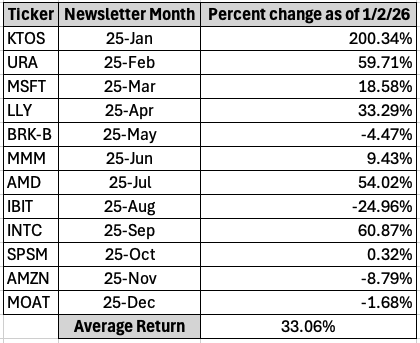
At the beginning of the year, we wanted to take a look back and see how our monthly stock picks managed in 2025 and were pleased to see an average return of 33%! May 2026 be full of higher returns!
$TSLA– Tesla’s rapid push in humanoid robotics and AI makes 2026 a potential inflection year. If Optimus moves from pilots to real factory roles, it could cut in-house costs and open a new, higher-margin revenue stream beyond cars.
As always, it’s not about timing the market, it’s about time in the market
Disclaimer: This is not financial advice or a recommendation for any investment. The content is for information purposes only, you should not construe any such information or other material as legal, tax, investment, financial, or other advice.
🚀 Your Supply Chain, Your Competitive Edge
Supply chains aren’t just about logistics, they’re about your bottom line, your growth, and your ability to outpace the competition. At Ena Source, we don’t just find suppliers; we engineer strategic supply chain solutions that cut costs, build resilience, improve reliability, and free up your cash flow.
If you’re curious how much you could be saving, let’s talk. No pressure. No cost. Just clarity.
📩 Click here to book a meeting. Resilient supply chains don’t happen by chance, they happen by choice. Let’s build yours, strategically.
Check Out Previous Newsletters At Our Website!
